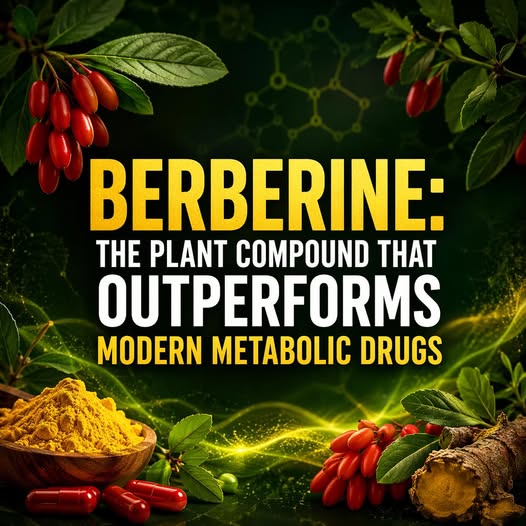
Berberine is not new.
It has been used in Traditional Chinese Medicine and Ayurveda for over 3,000 years — for infections, gut conditions, inflammation, and metabolic disorders. It is extracted from multiple plants including Berberis vulgaris (barberry), Berberis aristata (tree turmeric), Coptis chinensis (goldthread), and Hydrastis canadensis (goldenseal).
What is new is the science.
Over 5,000 published studies. Multiple randomized controlled trials. Head-to-head comparisons with pharmaceutical drugs including metformin, statins, and antibiotics. Documented activity across glucose metabolism, lipid regulation, gut health, neurological protection, cancer biology, and longevity pathways.
And a mechanism so fundamental — AMPK activation — that it touches virtually every metabolic process simultaneously.
This is not a supplement with a handful of interesting studies.
This is one of the most pharmacologically significant natural compounds ever identified.
 𝐖𝐇𝐀𝐓 𝐁𝐄𝐑𝐁𝐄𝐑𝐈𝐍𝐄 𝐈𝐒
Berberine is an isoquinoline alkaloid — a plant secondary metabolite with a distinctive bright yellow color and bitter taste.
It is found in the roots, bark, rhizomes, and stems of multiple plant species across different botanical families — suggesting it evolved independently multiple times as a defense compound. Plants producing berberine are among the most widely used medicinal plants across Asian, Middle Eastern, and Native American healing traditions.
The compound itself is identical regardless of plant source — the pharmacology of berberine from barberry is the same as from goldenseal or Coptis.
 𝐖𝐇𝐀𝐓 𝐁𝐄𝐑𝐁𝐄𝐑𝐈𝐍𝐄 𝐃𝐎𝐄𝐒 — 𝐓𝐇𝐄 𝐌𝐄𝐂𝐇𝐀𝐍𝐈𝐒𝐌𝐒
 𝐀𝐌𝐏𝐊 𝐀𝐜𝐭𝐢𝐯𝐚𝐭𝐢𝐨𝐧 — 𝐓𝐡𝐞 𝐂𝐨𝐫𝐞 𝐌𝐞𝐜𝐡𝐚𝐧𝐢𝐬𝐦:
AMPK — AMP-activated protein kinase — is the cellular energy sensor. When cellular energy falls — AMP rises relative to ATP — AMPK activates.
AMPK activation produces a cascade of metabolic effects:
• Increases glucose uptake in muscle cells — through GLUT4 translocation independent of insulin
• Reduces hepatic glucose production — suppressing gluconeogenesis
• Increases fatty acid oxidation — shifting metabolism toward fat burning
• Inhibits mTOR — activating autophagy and reducing cellular aging
• Stimulates mitochondrial biogenesis — through PGC-1alpha activation
• Reduces lipid synthesis — inhibiting SREBP-1c driven hepatic fat production
• Improves insulin sensitivity — through multiple downstream mechanisms
This is the same pathway activated by:
• Exercise — the most potent natural AMPK stimulus
• Caloric restriction and fasting
• Metformin — the most prescribed diabetes medication globally
Berberine and metformin activate AMPK through different mechanisms — berberine through inhibition of Complex I of the mitochondrial electron transport chain; metformin through the same pathway — producing overlapping but not identical effects.
This AMPK activation explains why berberine produces such broad metabolic benefits — it is not addressing a single pathway but activating the master metabolic regulator that governs dozens of downstream processes.
𝐆𝐮𝐭 𝐌𝐢𝐜𝐫𝐨𝐛𝐢𝐨𝐦𝐞 𝐌𝐨𝐝𝐮𝐥𝐚𝐭𝐢𝐨𝐧:Berberine has poor systemic bioavailability — typically less than 5% is absorbed into the bloodstream. For years this was considered a limitation.
It is now understood to be one of its greatest assets.
Berberine acts extensively in the gut — directly modulating the gut microbiome in ways that produce significant systemic metabolic effects:
• Reduces pathogenic bacteria — Staphylococcus, Streptococcus, Klebsiella, H. pylori
• Promotes beneficial species — Akkermansia muciniphila, Bifidobacterium, Lactobacillus
• Reduces gut-derived LPS production — reducing systemic metabolic endotoxemia and NLRP3 activation
• Increases short-chain fatty acid production — particularly butyrate — through prebiotic-like effects on fiber-fermenting bacteria
• Reduces intestinal permeability — strengthening tight junction proteins
The Akkermansia connection is particularly significant — berberine is one of the most potent Akkermansia-stimulating compounds identified, and much of its metabolic benefit may be mediated through Akkermansia-driven gut barrier restoration and GLP-1 signaling.
𝐋𝐢𝐩𝐢𝐝 𝐌𝐞𝐭𝐚𝐛𝐨𝐥𝐢𝐬𝐦:Berberine reduces LDL cholesterol through a mechanism completely different from statins:
Statins inhibit HMG-CoA reductase — reducing cholesterol synthesis in the liver.
Berberine upregulates LDL receptors — increasing the liver’s capacity to clear LDL from the bloodstream. It does this through PCSK9 inhibition — reducing the degradation of LDL receptors and allowing more to remain on hepatocyte surfaces.
This is the same mechanism targeted by the most expensive class of cholesterol-lowering drugs — PCSK9 inhibitors (alirocumab, evolocumab) — which cost thousands of dollars per month.
Additionally berberine:
• Reduces triglycerides — through AMPK-mediated inhibition of hepatic lipogenesis
• Raises HDL — through multiple mechanisms
• Reduces VLDL production — addressing hepatic insulin resistance-driven dyslipidemia
𝐀𝐧𝐭𝐢-𝐈𝐧𝐟𝐥𝐚𝐦𝐦𝐚𝐭𝐨𝐫𝐲 𝐄𝐟𝐟𝐞𝐜𝐭𝐬:• Inhibits NF-kB — reducing inflammatory gene expression
• Inhibits NLRP3 inflammasome — directly reducing IL-1beta production
• Reduces TNF-alpha, IL-6, and IL-1beta
• Reduces neuroinflammation — crosses the blood-brain barrier and inhibits microglial activation
• Reduces adipose tissue inflammation — through macrophage polarization toward M2 anti-inflammatory phenotype
𝐀𝐧𝐭𝐢𝐦𝐢𝐜𝐫𝐨𝐛𝐢𝐚𝐥 𝐀𝐜𝐭𝐢𝐯𝐢𝐭𝐲:Berberine has broad-spectrum antimicrobial activity — one of its most ancient and most validated applications:
• Antibacterial — active against MRSA, H. pylori, E. coli, Klebsiella, Salmonella, and multiple other pathogens
• Antifungal — Candida albicans including fluconazole-resistant strains
• Antiparasitic — Giardia, Leishmania, Plasmodium (malaria)
• Antiviral — influenza, herpes simplex, SARS-CoV-2 in vitro
Berberine’s antimicrobial mechanism involves DNA intercalation — inserting into bacterial DNA and disrupting replication — a mechanism that makes resistance development significantly slower than with standard antibiotics.
𝐍𝐞𝐮𝐫𝐨𝐥𝐨𝐠𝐢𝐜𝐚𝐥 𝐄𝐟𝐟𝐞𝐜𝐭𝐬:• Crosses the blood-brain barrier — direct CNS activity
• Inhibits acetylcholinesterase — the enzyme that breaks down acetylcholine; the same mechanism as Alzheimer’s pharmaceutical drugs (donepezil)
• Reduces neuroinflammation
• Reduces amyloid-beta and tau phosphorylation — in multiple Alzheimer’s models
• Antidepressant effects — through monoamine modulation and neuroinflammation reduction
• Neuroprotective against oxidative damage
𝐀𝐧𝐭𝐢𝐜𝐚𝐧𝐜𝐞𝐫 𝐌𝐞𝐜𝐡𝐚𝐧𝐢𝐬𝐦𝐬:• Induces apoptosis across multiple cancer cell lines
• G1/S cell cycle arrest — preventing cancer cell replication
• Inhibits mTOR — reducing cancer cell proliferation
• Anti-angiogenic — reduces VEGF
• Cancer stem cell inhibition — through Wnt and Hedgehog pathway suppression
• Sensitizes cancer cells to chemotherapy
• Particularly studied for: colorectal, breast, lung, liver, and cervical cancers
𝐆𝐮𝐭-𝐒𝐩𝐞𝐜𝐢𝐟𝐢𝐜 𝐄𝐟𝐟𝐞𝐜𝐭𝐬:Beyond microbiome modulation — berberine directly addresses gut conditions:
• Reduces gut motility in diarrhea — through multiple mechanisms; one of the oldest and most effective natural anti-diarrheal compounds
• Reduces intestinal inflammation in IBD
• H. pylori eradication — enhances standard triple therapy efficacy in clinical trials
• Reduces intestinal secretion — addressing secretory diarrhea from cholera toxin and E. coli
• Protects intestinal epithelial cells from inflammatory damage
 𝐓𝐇𝐄 𝐌𝐄𝐓𝐅𝐎𝐑𝐌𝐈𝐍 𝐂𝐎𝐌𝐏𝐀𝐑𝐈𝐒𝐎𝐍 — 𝐓𝐇𝐄 𝐌𝐎𝐒𝐓 𝐈𝐌𝐏𝐎𝐑𝐓𝐀𝐍𝐓 𝐂𝐋𝐈𝐍𝐈𝐂𝐀𝐋 𝐅𝐈𝐍𝐃𝐈𝐍𝐆
The comparison between berberine and metformin is one of the most cited and most significant findings in natural medicine research.
The landmark 2008 study by Yin et al. (Journal of Clinical Endocrinology & Metabolism) — a randomized controlled trial in type 2 diabetic patients — found:
Berberine 500mg three times daily vs. metformin 500mg three times daily over 3 months:
• HbA1c reduction: berberine reduced by 2.0%; metformin by 1.8% — comparable
• Fasting blood glucose: berberine reduced by 26%; metformin by 23% — comparable
• Post-meal glucose: berberine reduced by 26%; metformin by 22% — comparable
• Triglycerides: berberine reduced significantly; metformin did not — berberine superior
• Total cholesterol: berberine reduced significantly; metformin did not — berberine superior
• Body mass index: comparable reductions
A subsequent meta-analysis of 27 clinical trials confirmed berberine produces glycemic outcomes comparable to standard oral antidiabetic drugs including metformin, glipizide, and rosiglitazone.
This is not a minor finding. A natural plant compound — available without prescription — producing glycemic outcomes comparable to the most prescribed diabetes drug globally, with additional lipid benefits metformin does not provide.
The limitations:
• Most trials are Chinese studies — methodological quality varies
• Long-term cardiovascular outcome data for berberine does not exist to the degree it does for metformin
• Metformin has established longevity benefits beyond glucose lowering — mTOR inhibition, microbiome effects, anti-cancer properties — that are increasingly being studied for berberine but are not yet as established
The honest conclusion: berberine is a genuinely impressive metabolic compound — comparable to metformin for glucose and superior for lipids — but it is a complement to, not necessarily a replacement for, pharmaceutical management in diagnosed type 2 diabetes without medical supervision.
𝐂𝐎𝐍𝐃𝐈𝐓𝐈𝐎𝐍𝐒 𝐖𝐈𝐓𝐇 𝐒𝐓𝐑𝐎𝐍𝐆𝐄𝐒𝐓 𝐄𝐕𝐈𝐃𝐄𝐍𝐂𝐄 Insulin resistance and metabolic syndrome:
The most evidence-supported application. Multiple RCTs demonstrating:
• Reduced fasting insulin and HOMA-IR
• Improved fasting and post-meal glucose
• Reduced HbA1c
• Improved insulin receptor sensitivity
• Weight reduction — particularly visceral fat
• Improved triglycerides and HDL
Type 2 diabetes:As described above — comparable to metformin in RCTs. Most appropriate as:
• An adjunct to lifestyle change for newly diagnosed or pre-diabetic patients
• A complement to conventional treatment under physician supervision
• A transition support when pharmaceutical reduction is a goal with appropriate medical oversight
Dyslipidemia:• Reduces LDL-C — through PCSK9 inhibition and LDL receptor upregulation
• Reduces triglycerides — often dramatically; 20–40% reductions documented
• Raises HDL
• Reduces ApoB
• Multiple RCTs confirm lipid benefits independent of glucose effects
PCOS:• Directly addresses the insulin resistance driving PCOS pathology
• Reduces testosterone in women with PCOS — through insulin sensitization reducing androgen production
• Improves menstrual regularity
• Improves ovulation frequency — in some trials comparable to metformin for ovulation induction
• Reduces LH:FSH ratio
• A landmark trial comparing berberine to metformin to rosiglitazone for PCOS showed berberine superior for metabolic markers and comparable for reproductive outcomes
Non-alcoholic fatty liver disease:• Reduces hepatic fat accumulation — through AMPK-mediated inhibition of hepatic lipogenesis
• Reduces liver enzymes — ALT and AST
• Reduces hepatic inflammation
• Addresses the insulin resistance driving NAFLD progression
• Multiple clinical trials demonstrating meaningful reduction in liver fat by imaging
Gut infections:• H. pylori — enhances eradication when added to standard triple therapy
• Traveller’s diarrhea — one of the most evidence-supported natural interventions
• Acute infectious diarrhea — reduces duration and severity across multiple pathogens
• SIBO — reduces bacterial overgrowth in the small intestine through direct antimicrobial effects and improved gut motility
Cardiovascular risk:• Reduces multiple cardiovascular risk markers simultaneously — LDL, triglycerides, blood glucose, insulin, inflammation, blood pressure
• The combination of effects on LDL receptor upregulation, NLRP3 inhibition, and endothelial function improvement makes berberine broadly cardioprotective
• Long-term cardiovascular outcome data is the primary evidence gap
Alzheimer’s disease — emerging:• Multiple mechanisms relevant to Alzheimer’s — acetylcholinesterase inhibition, amyloid reduction, tau phosphorylation reduction, neuroinflammation suppression
• Early human trials showing cognitive improvements in mild cognitive impairment
• One of the most mechanistically rational natural compounds for Alzheimer’s prevention
 𝐒𝐔𝐏𝐏𝐋𝐄𝐌𝐄𝐍𝐓𝐀𝐓𝐈𝐎𝐍 — 𝐅𝐎𝐑𝐌𝐒, 𝐃𝐎𝐒𝐄𝐒, 𝐀𝐍𝐃 𝐁𝐈𝐎𝐀𝐕𝐀𝐈𝐋𝐀𝐁𝐈𝐋𝐈𝐓𝐘
The bioavailability challenge:
Standard berberine has poor oral bioavailability — typically 1–5%. Much of the systemic activity occurs through gut microbiome modulation and intestinal effects rather than systemic absorption. This is why gut-mediated effects are so prominent.
Enhanced bioavailability forms:
Dihydroberberine (DHB):• A reduced form of berberine — produced naturally in the gut through bacterial metabolism of berberine
• Significantly better absorbed than berberine — approximately 5x higher systemic bioavailability
• Converted back to berberine in tissues
• Produces equivalent or superior metabolic effects at lower doses with less GI irritation
• Dose: 100–200mg twice daily — equivalent to 500mg berberine twice daily
• The preferred form for anyone experiencing GI side effects with standard berberine
Berberine phytosome:• Bound to phospholipids — improving intestinal absorption
• Better systemic bioavailability than standard berberine
• Reduced GI side effects
Standard berberine HCl:• The most widely available and most studied form
• Despite poor bioavailability — produces significant metabolic effects through gut-mediated mechanisms
• Take with food to reduce GI side effects
• Dose: 500mg 2–3 times daily with meals
Dosing:
• Metabolic and glucose applications: 500mg berberine HCl three times daily with meals — the dose used in most clinical trials
• Lipid reduction: 500mg twice daily
• Gut infection: 400–500mg three times daily
• Dihydroberberine: 100–200mg twice daily
Timing:
• Always with food — reduces GI side effects and improves absorption with dietary fat
• Split doses are more effective than single large doses — due to short half-life
The GI side effect reality:
Berberine causes GI discomfort — bloating, cramping, diarrhea, or constipation — in a significant proportion of users, particularly at higher doses. This is partly the antimicrobial effect disrupting existing microbiome balance during initiation.
Management:
• Start low — 250mg once daily for 1–2 weeks before increasing
• Always with food
• Consider dihydroberberine for better tolerability
• Side effects typically improve after 2–4 weeks as microbiome adapts
 𝐂𝐘𝐂𝐋𝐈𝐍𝐆 𝐁𝐄𝐑𝐁𝐄𝐑𝐈𝐍𝐄 — 𝐖𝐇𝐘 𝐈𝐓 𝐌𝐀𝐓𝐓𝐄𝐑𝐒
Berberine is powerful — but it’s not something most people should take endlessly without breaks.
Because of its antimicrobial activity, AMPK activation, and microbiome effects, long-term continuous use can lead to adaptation or unwanted shifts.
Here’s how to use it intelligently:
 Option 1 — cycled use (most recommended)
• 8–12 weeks on
• 2–4 weeks off
Why this works:
• Prevents microbiome over-suppression
• Reduces tolerance/adaptation
• Allows your body to maintain its own metabolic signaling
• Mimics natural “stress–recovery” cycles (like fasting/exercise)
 Option 2 — pulsed weekly use
• 5 days on
• 2 days off
Best for:
• Long-term metabolic support
• People sensitive to continuous antimicrobial pressure
• Maintaining benefits without overstressing the gut
 Option 3 — targeted use
Use only when needed:
• During gut protocols (SIBO, candida, infections)
• During high blood sugar phases
• During metabolic “reset” periods
Then stop once the goal is achieved.
 Why cycling is important
Berberine is not just a supplement — it behaves more like a botanical drug-level compound
So continuous use can:
• Alter microbiome diversity over time
• Downregulate natural metabolic flexibility
• Increase risk of GI irritation in some people
• Interact with nutrient absorption long term
 Smart strategy
During off cycles:
• Focus on diet + movement (your natural AMPK activators)
• Support gut with fiber + polyphenols
• Use gentler tools (e.g. bitters, minerals, sunlight, circadian rhythm)
This keeps your metabolism self-driven — not supplement-dependent
𝐁𝐄𝐑𝐁𝐄𝐑𝐈𝐍𝐄 𝐈𝐍 𝐂𝐎𝐌𝐁𝐈𝐍𝐀𝐓𝐈𝐎𝐍Berberine works synergistically with multiple compounds:
Berberine + alpha lipoic acid:• Synergistic insulin sensitizing — complementary AMPK activation mechanisms
• Better glycemic outcomes than either alone in clinical trials
Berberine + milk thistle:• Berberine improves metabolic function; milk thistle protects hepatocytes and upregulates glutathione
• Particularly rational for NAFLD where both liver protection and metabolic improvement are needed
Berberine + quercetin:• Complementary NF-kB and NLRP3 inhibition
• Combined gut microbiome benefits
• Synergistic anti-inflammatory effects
Berberine + curcumin:• Complementary anti-inflammatory mechanisms
• Combined anticancer pathway coverage
• Mutual microbiome-supporting effects
Berberine + inositol (for PCOS):• Berberine addresses insulin resistance; myo-inositol improves insulin signaling at the receptor level
• Combined approach produces superior PCOS outcomes than either alone in clinical observations
Berberine + CoQ10:• Berberine inhibits Complex I of the mitochondrial chain — the same mechanism as metformin
• This may reduce CoQ10 synthesis through the mevalonate pathway — similar to statins
• Co-supplementation with CoQ10 is rational particularly at higher doses or with prolonged use
𝐂𝐀𝐔𝐓𝐈𝐎𝐍𝐒 𝐀𝐍𝐃 𝐈𝐍𝐓𝐄𝐑𝐀𝐂𝐓𝐈𝐎𝐍𝐒Drug interactions — the most important consideration:
• CYP3A4 and CYP2D6 inhibition — berberine significantly inhibits these drug-metabolizing enzymes; interactions with medications metabolized through these pathways including cyclosporine, tacrolimus, some statins, certain antidepressants, and antiarrhythmics; discuss with physician before use if on multiple medications
• Metformin — the combination may produce additive glucose-lowering; monitor blood glucose; potential hypoglycemia risk particularly in type 2 diabetics
• Anticoagulants — berberine has antiplatelet activity; may potentiate warfarin; discuss with physician
• Antihypertensives — additive blood pressure lowering possible; monitor
• P-glycoprotein inhibition — may increase the absorption of P-gp substrate medications
Pregnancy:
• Berberine crosses the placenta — documented uterotonic effects in some studies; avoid during pregnancy; potentially contraindicated particularly in the third trimester
Breastfeeding:
• Berberine passes into breast milk; avoid during breastfeeding; neonatal jaundice is a theoretical concern
Hypoglycemia risk:
• In combination with other glucose-lowering medications or insulin — berberine may cause hypoglycemia; monitor blood glucose carefully
Neonatal use:
• Berberine can displace bilirubin from albumin — contraindicated in neonates due to jaundice risk
Autoimmune conditions:
• Berberine’s immune-modulating effects are complex; discuss with practitioner for autoimmune conditions on immunosuppressive therapy
 𝐓𝐇𝐄 𝐃𝐄𝐄𝐏𝐄𝐑 𝐓𝐑𝐔𝐓𝐇
Berberine has been hiding in plain sight for 3,000 years.
In the barberry shrubs of the Mediterranean and Central Asia. In the goldenseal of North American indigenous medicine. In the Coptis root of Chinese herbal formularies. In the tree turmeric of Ayurvedic practice.
Every tradition that had access to berberine-containing plants — used them for the same conditions. Infections. Gut disorders. Metabolic dysfunction. Inflammatory conditions.
They did not know about AMPK. They did not know about PCSK9. They did not know about Akkermansia.
But they observed — across thousands of years of empirical medicine — that these plants worked. Consistently. Broadly. In ways that defied the single-condition framing that modern pharmaceutical medicine applies.
Because berberine does not treat a single condition.
It activates a master metabolic switch — AMPK — that the human body evolved to use during periods of energetic stress, physical demand, and caloric scarcity. It modulates the gut ecosystem that governs metabolic function from the inside. It inhibits the inflammatory pathways that convert metabolic dysfunction into tissue damage.
It is, in the most literal sense, a metabolic medicine — addressing the root conditions of modern chronic disease rather than managing their downstream expressions.
The comparison to metformin is not hyperbole. It is the result of randomized controlled trials.
The additional lipid benefits beyond metformin are not theoretical. They are documented.
The gut microbiome effects — particularly Akkermansia enrichment — may explain metabolic benefits that extend beyond what AMPK activation alone accounts for.
Use it correctly. Start low. Take with food. Choose dihydroberberine if GI tolerance is an issue. Declare it to your physician if you are on medications.
And understand that the most evidence-supported natural metabolic compound available — the one that outperformed metformin in clinical trials — costs a fraction of a pharmaceutical prescription and has been available in health food stores for decades.
The knowledge was always there.
The science just finally caught up.
All my content is 100% free so that everyone can benefit — especially in a world where healthcare costs are rising beyond reach. Your support means everything. It helps me keep The Healing Hub — my page where I share free healing guides and root-cause wellness tools — growing and accessible to all.
Every donation means more education in the hands of people — and less money in the pockets of Big Pharma!
 𝐄𝐗𝐏𝐋𝐎𝐑𝐄 𝐌𝐎𝐑𝐄 𝐅𝐑𝐄𝐄 𝐇𝐄𝐀𝐋𝐈𝐍𝐆 𝐓𝐎𝐎𝐋𝐒:
→ Tap Pete Wurst
→ Scroll to the top pinned post
That’s where the Healing Hub Library is.